
Travel Photography Tips & Insights
A Pocket Guide to Exploring Milan: Beyond Fashion Week
Feb
Last year, when I was busy photographing a fashion show in Italy I realized that many people drop in for the runways, the afterparties, and then leave- leaving almost no time to explore the local neighborhoods and city highlights. To sit in cafes and restaurants with the locals, or to listen to live music and immerse themselves.
I remember thinking about how much they were missing out on, but I also realized they probably didn’t have the time to look for information. I mean – I’ve been in the exact same position during many of my trips to Milan. Show up, work all day, eat late, wake up early, and go home.
That’s why I wrote this blog to begin with, in an attempt to try to provide some more resources so that if you’re visiting Milan for Fashion Week, or really at any point during the year – that you can hopefully have some additional information that will maybe inspire you to book an extra day or two, or maybe even just spend an extra hour or two exploring the city and getting to know Milan a bit better.
The places to walk when you have an hour before shows. Some neighborhoods to explore when you want to decompress. The cafés, parks, and side streets that make the experience fuller.
As a preface, this guide isn’t perfect, and perfection isn’t the goal. Think of it as a foundational resource built with intention, with the hope that it will evolve through future feedback. Imagine a wrinkled map that a weathered traveler has refreshed just enough to pass along to you. If that sounds interesting, let’s explore it together. If you have ideas for how this could become more useful so others can benefit too, I would genuinely love to hear them. Leave a comment, contact me directly, or send a DM on Instagram. I’m looking forward to your feedback. For now, here’s what I’ve put together so far-
Welcome to Milano
CHAPTERS – To make your life easier, I’ve sorted the information in this guide into chapters, and have included some chapter highlights. Click on the chapter name to see the full chapter details.
City Highlights
- Duomo di Milano: Gothic cathedral and symbolic heart of Milan.
- Galleria Vittorio Emanuele I: Italy’s oldest shopping mall.
- Teatro alla Scala: Milan’s historic opera house and cultural institution.
- Sforzesco Castle: Historic fortress with multiple museums inside.
- San Bernardino alle Ossa: Ossuary with decorative human remains
Neighborhoods
- City Center: Main Highlights
- Isola: Unique architecture
- Naviglio: Canals, bars and restaurants alongside canals
- Via Paolo Sarpi: Chinatown
- Porta Romana: Foodie land
- Porta Venezia: LGBTQ+, independent cafes
Drinking Holes
- Bar Luce: Designed by Wes Anderson
- The Walrus: Craft beers
- La Buttiga Beer Room: Craft beers
- Tutti Fritti – No frills solid drinking hole, local favorite.
- Tap – Craft beer.
Food
- Pesa dal 1902: Traditional Milanese Cuisine
- Al Garghet: Traditional Milanese Cuisine
- Barragán – Great Mexican Tacos
- Mercato Ittico Milano – The largest fish market in Italy
- Pavé: Panettone, Gelato, etc.
- Panzerotti Luini: Puglia
- All’Antico Vinaio: Tuscan schiacciata
- Pescaria: Seafood sandwiches
- Deus Cafe Isola – Coffee, Drinks, Food & Motorcycles
- Ristorante Indiano Shiva
- Porcobrado: Pork-based panini
- Ammu: Sicilian cannoli
- Pizza AM
- Vincenzo Capuano: Pizza
- Gino Sorbillo: Pizza
- Gelato Fatto con Amore
- Ciacco: Gelato
- Casa Ramen
- BAM Brewery Brew Risto Pub
Live Music
- Nidaba Theatre: Intimate venue
- Blue Note : Jazz bar
- Spirit de Milano: Restaurant with performances
Art & Culture
- The Apple Made Whole Again, Michelangelo Pistoletto
- L.O.V.E, Maurizio Cattelan
- The Museo del Novecento
- Last Supper, Leonardo da Vinci
- Saint Bartholomew Flayed, Marco d’Agrate
- Cimitero Monumentale
- Kiss, Francisco Hayez
- Codex Atlanticus, Leonardo da Vinci
Parks & Green Areas
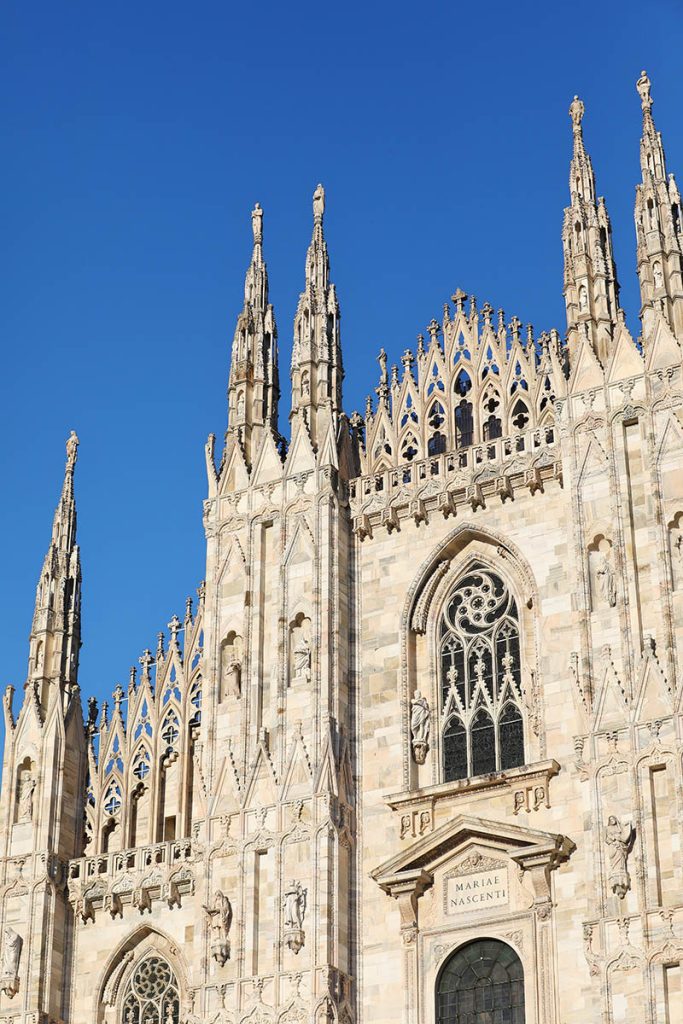
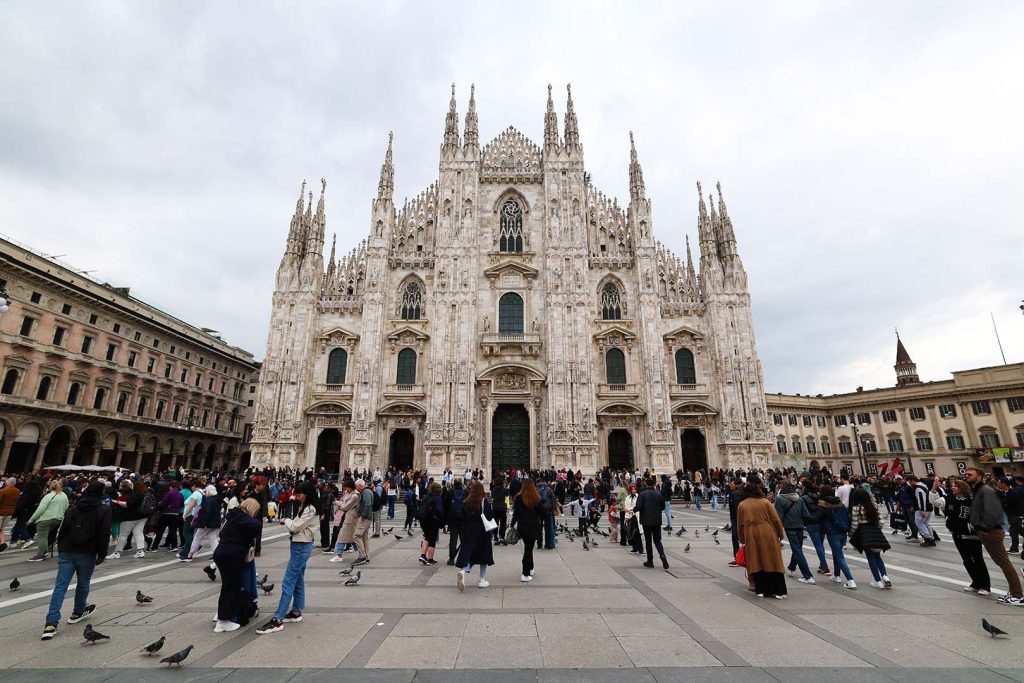
Whenever I talk to my friends about Milan, the classic city highlights are always the first check box on their list and for good reason. So, the first place to explore would be the Duomo di Milano. This gothic cathedral is awesome and took 579 years to build. It’s one of the few cathedrals in the world where you can walk on the rooftop and it’s especially beautiful at sunset. There are thousands of statues and spires up there, each with unique detail only visible once you zoom in closer.
Right next door to the Duomo is the super impressive Galleria Vittorio Emanuele II, which was designed by Giudseppe Mengoni. Completed in 1877, it was an early shopping arcade and is apparently Italy’s oldest active shopping arcade.
Inside you’ll find some of the big brand names. The locals call it “il salotto di Milano” (Milan’s living room) and part of the fun is sipping an espresso in one of the historic cafes and people watching. While you’re doing that you might be surprised to see people spinning around in one particular spot on the floor. Take a closer look and you’ll see that they’re actually spinning on a mosaic bull’s err balls. Legend says that you’ll have good luck – although I’ve no idea why!
Then, just literally three minutes walk away is the Teatro alla Scala. It actually replaced the first opera theatre, Teatro Regio Ducale, which was destroyed by fire in 1776. The opera season starts at the beginning of December every year and is a great time to see the latest premieres. With nearly 250 years of history, it stands as one of the leading opera houses in the world.
Now if you walk about 10-15 minutes, just behind the Duomo area you’ll eventually end up at Sporza Castle. In fact, you can’t miss it! It’s like a massive fortress with stately brick towers and huge courtyards.
Before you get confused, let me quickly explain about the name of the castle. So technically it’s called Castello Sforzesco which is Sforza Castle in English. So, why did Sforza become Sporza? Well, in Italian “sf” it’s pronounced a little roughly and that sound is hard for English-speaking tourists, so naturally over the years it got misheard and accepted as a “sp” sound.
So, just remember that Castello Sforzesco, Sforza Castle and Sporza Castle are all the same place.
The courtyards at the castle are free and open all day. Inside the castle, there’s quite a few museums and exhibitions, so it’s easy to kill a few hours. They also offer 90-minute tours. One of the highlights is Michelangelo’s final unfinished sculpture, the Rondanini Pietà.
I’d also tell you to hit up San Bernardino alle Ossa which is an ossuary where you can see the final resting place of thousands of human bones. The bones are arranged decoratively, it feels super intense and eerily quiet.
So, I feel like we’ve spoken a lot about what’s in the Milan city center already at this point, since we’ve seen the Duomo, Galleria, La Scala, Castello Sforzesco, etc so let’s explore a little bit further.
One of the things I find most compelling about Milan is the way it treats its past. It doesn’t really flatten things and then start over, it keeps the history and kind of builds on top. And one of the best neighborhoods to see this unique approach is Isola.
As you walk through the neighborhood, you’ll go past former industrial buildings and older residential blocks. Then, as you move toward Corso Garibaldi and the financial district, everything kind of shifts and glass and steel begin to rise high behind those older façades.
And then you look up and see Bosco Verticale. There are two residential towers that have been planted with more than 900 trees and thousands of shrubs. Yes, it’s a visual statement but also a functioning structure. It kind of reminds me of the art piece I introduced earlier – The Apple Made Whole Again – that fine line between technology and nature.
You do not see this kind of contrast clearly in other Italian cities. For example, as you can see in my collections of Florence, history still tends to dominate the skyline.
Then, Naviglio: this whole district is known for its bohemian and picturesque vibes, don’t be put off by the graffiti which I think adds another layer or dimension to the area. The walk along the canals during the day and evening are both really pretty. During the day, the blue sky kind of reflects off the canal waters and people enjoy sitting outside with a coffee and people watching. Especially in the late afternoon and evening, the atmosphere becomes lively, with people spilling into the restaurants, bars and terraces to enjoy an aperitivo.
Personally, I love waiting near the restaurants of Naviglio Grande at around aperitivo time, just after work before heading home, to see what I can capture with my camera. I think the aperitivo tradition is one of my all-time-favorites. It’s usually a Negroni or Aperol Spritz served with some light food, like breads and olives or more like a buffet.
Did you know that Milan has a China town? It’s on Via Paolo Sarpi and it’s actually one of the largest communities in Italy. If you’ve followed me for a while, you’ll know that I love starting my shoots with a coffee and a pastry. Well, here in China town are bakeries that have pastries that you really can’t find anywhere else in Milan. And of course, there’s a tonne of Chinese and fusion restaurants. Generally, it has a much more lived-in and residential vibe than some of the other neighborhoods.
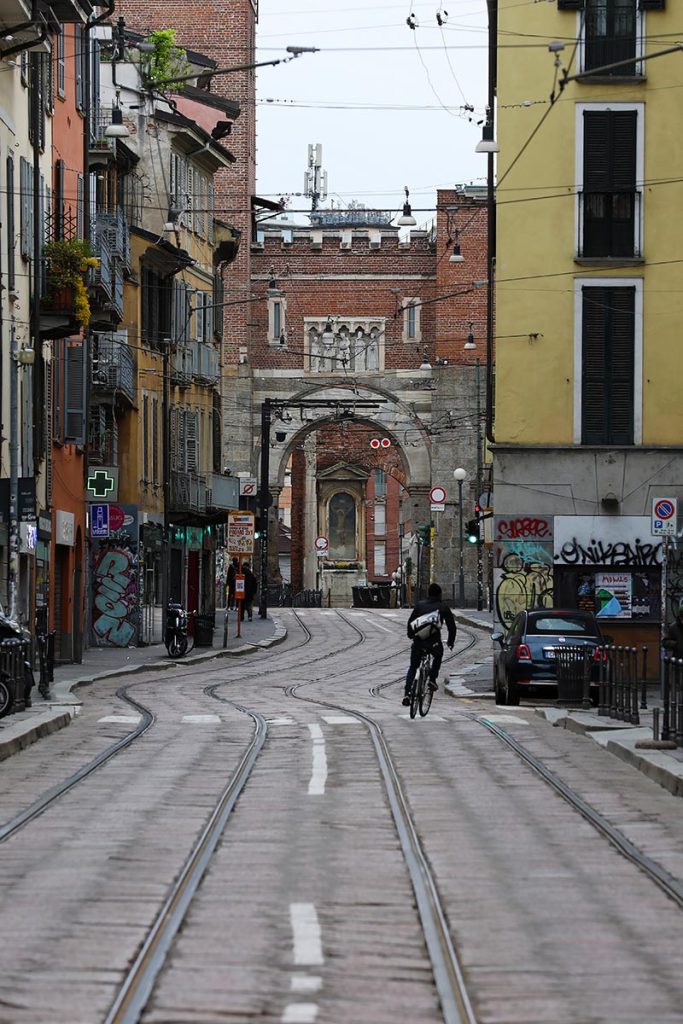
Cinque Vie – Milan’s oldest neighborhood, a quiet maze of narrow streets, historic buildings, artisan workshops, and hidden courtyards just west of the Duomo. It’s especially pleasant to explore on a Saturday, when the area feels calm, local, and almost removed from the crowds elsewhere in the center. Each April during Design Week, many studios, galleries, and private spaces open to the public, revealing interiors and installations normally hidden behind heavy wooden doors.
If you’re a big foodie, I’d definitely recommend hitting up the Porta Romana neighbourhood in Milan. There’s a strong restaurant scene here and it’s where a lot of the locals go to eat, since they don’t want the tourist prices of central areas. So, you know the deal… eat where the locals eat and you won’t be disappointed. It’s comfortable and is a great neighborhood to unwind after the glitz and glam of the Milan fashion show and runway.
Finally, the area of Porta Venezia feels open in a way other parts of Milan don’t. For starters the streets are wider and it is generally one of the more diverse areas to explore. There’s lots of independent shops and cafes. It also has a stronger LGBTQ+ presence, particularly around Via Lecco, often referred to as Milan’s Rainbow District. Nearby Via Lincoln offers a completely different kind of charm — a tiny street lined with pastel-colored houses originally built as a working-class neighborhood.
If you go, be sure to check out Villa Invernizzi because you might spot the flamingos that live there! Bet you didn’t know there were flamingos in Milan?!

Any Wes Anderson fans reading this? If so, Bar Luce would be awesome to visit. It’s in the entrance building of Fondazione Prada and when designing it he was inspired by the 1950s and 60s Milanese coffee bars. During the day, it’s a cafe and in the evening it shifts into a bar with cocktails and wine.
Personally though I’m a huge craft beer fan – in fact whenever I travel I always keep a list of all the craft beer spots I visit. And, in Milan the Walrus Pub would be a dependable choice. This place is known for having super chill and welcoming staff. It’s an easy place to settle in for a few.
Then, La Buttiga Beer Room near Via Paolo Sarpi has twelve taps and a beer shop so you can grab one for the road. It’s straightforward and I appreciate places like that.

Milan has changed a great deal over the years, and its food scene reflects that shift. There’s a lot more fusion cuisine and different regional specialities from across Italy. Milanese cuisine can be a little bit harder to find, so lets start there.
If you want classic dishes such as risotto alla Milanese, ossobuco, or cotoletta, places like La Pesa dal 1902 and Al Garghet are reliable starting points. These restaurants keep the city’s culinary identity alive through recipes that are rich and rooted in tradition.
Milan is also surprisingly strong when it comes to seafood. The Milan Fish Market is one of the largest in southern Europe, receiving fresh fish daily for distribution to restaurants across the city. That supply chain makes it possible to eat excellent fish here, even though Milan is far from the coast. The unsold fish returns to its region of origin, maintaining a tight cycle between producer and market.
Here’s some other local favorites food spots:
- Pavé is most well known for its panettone
- Panzerotti Luini for the Puglia, small folded pastries filled with tomato and mozzarella, fried or baked
- All’Antico Vinaio is a casual joint for Tuscan schiacciata
- Pescara for the seafood sandwiches
- Porcobrado sells probably the best pork-based panini
- Ammu specializes in Sicilian cannoli
- Pizza AM (pizza)
- Vincenzo Capuano (pizza)
- Gino Sorbillo (pizza)
Now, after all that good food I know the next thing you’ll want is gelato. Traditional italian ice cream. I’d stay away from the large tourist driven chains and instead keep your eyes open for smaller artisanal producers. One way to check is simply to look at the colors. If they look like bubblegum colors, bright and vivid – go somewhere else. Luckily, I know where to look in Milan for great gelato:
- Gelato Fatto con Amore
- Crema Alta Gelateria
- Ciacco

If you want to get up close and personal to some music, I’d recommend Nidaba Theatre. And by ‘close up’ I mean close enough to feel the sweat. It’s small and there is basically no chance of getting a seat. But, then again you’re there for the music and that happens pretty much every night of the week.
For jazz fans you’ll be happy that Milan actually has a Blue Note. It’s the same as all the other locations – top notch jazz performances, more often international artists visit.
Spirit de Milan is also a good option. Technically it isn’t a live music venue, it’s actually a restaurant in an old industrial factory that has performances. If you’ve been to Hungary, it kind of reminds me of the ruin bars in old warehouses. There it is again, that concept of building something new out of something old – I feel like I’ve mentioned it a lot in this pocket guide, right. Anyway, the ceilings are massive, there are long communal tables and tons of room to dance around. Music-wise they tend to switch between swing, rock, and traditional Italian music.

The first piece of art you’ll stumble across in Milan is at Milano Centrale, the city’s main train station. The sculpture The Apple Made Whole Again (gmap) was made by Michelangelo Pistoletto. It is meant to symbolize the relationship between nature and the artificial world being mended.
Another public piece is L.O.V.E, also known as “The Fingers” by the locals, in Piazza degli Affari. The sculpture is a marble hand with its middle finger raised, while the other fingers look like they’ve been severed off. At first glance, it seems pretty blunt as a statement, especially given its placement in the financial district. It was originally only meant to be there for one week, but months after and with a hefty dose of controversy, it became a permanent piece! Hats off to the artist Maurizio Cattelan for sure on this one.
You can drop into The Museo del Novecento for 20th century art. It’s right on the Piazza del Duomo, so is an easy next stop after the Duomo. And, in fact, from the top floors there are some amazing views of the Duomo itself. I thought that the spiral ramp style layout of the museum itself is kind of cool. It basically guides you through time and art movements like Futurism and Metaphysical Art as you climb higher and higher.
In fact, one of my favorite statues, ‘Saint Bartholomew Flayed’ by Marco d-Agrate is inside the Duomo. Another ‘Madonna and child?’ Pass! To be honest, I just find gothic statues so fascinating, like it’s obviously so grotesque… but I can’t look away. This particular one shows the Saint wearing his own skin like a cloak. It’s gross, but I truly appreciate the craftsmanship and the artists dedication to their art – even if I probably would have picked something… a bit lighter. That’s gothic for you I guess. I must be a renaissance man at heart?!
Here some other places you might want to visit if you have time:
- Santa Maria Delle Grazie A UNESCO World Heritage Site with Leonardo da Vinci’s Last Supper
- Cimitero Monumentale Yes, it’s a cemetery, but feels more like an open-air art gallery full of marble angels, bronze statues and gothic decorations.
- Pinacoteca di Brera Home of the famous Kiss by Francisco Hayez and works by Raphael, Caravaggio and Mantegna.
- Pinacoteca Ambrosiana, exhibits part of Leonardo da Vinci’s Codex Atlanticus.
- San Maurizio al Monastero Maggiore – Also known as the Sistine Chapel of Milan
- Museo Civico Archeologico – Milan’s archeological museum located next to San Maurizio al Monastero Maggiore.
- San Satiro (Bramante’s Trompe-l’Œil)
- Basilica di Santo Stefano Maggiore The larger church beside the ossuary, notable as Caravaggio’s baptism site and the location of the 1476 assassination of Duke Galeazzo Maria Sforza.
- Basilica di Sant’Ambrogio A remarkably serene Romanesque church that feels far older than the surrounding city, often described as a place of silence and contemplation.
These spots have rotating exhibitions so check what’s happening during your time in Milan:

Sneakily tucked away it’s easy to miss the botanical gardens Orto Botanico di Brera, but it would be such a shame if you did! It was made, originally for medicinal plants, in 1774 by Austrian Empress Maria Theresa. It’s like a little quiet place to breathe in the middle of Milan. It’s totally free to enter and you can have a gentle stroll around for like 30 minutes or so. It may not have the grandeur of many other botanical gardens around the world, but I think that only adds to the charm.
For a larger space, head to the Parco Sempione which runs behind the back of the Castello Sforzesco and is the most central green area. It is designed in a traditional 19th Century English style. It’s super popular in the warm months to see people picnicking, musicians practising and runners.
Across from Santa Maria delle Grazie, the UNESCO site with Leonardo’s “Last Supper”, is his vineyard (gmap). In 1498, Ludovico Sforza, the former Duke of Milan, gifted it to Leonardo as a thanks for his in Milan. Naturally, the original vines died over time but a group of researchers managed to figure out which type of grapes they were. Then, it was fully replanted – so it might not be the original, but it’s still pretty cool.
Martesana Canal bike ride (Naviglio della Martesana)- If you feel like renting a bike, this is one of the nicest calm rides that starts right in the city. Start at Cassina de’ Pomm (Via Melchiorre Gioia), then follow the canal path as it cuts past Viale Monza and through the up-and-coming NoLo area, before turning greener as you head out toward Cernusco sul Naviglio and, if you want a longer day, all the way to Cassano d’Adda.
Finally, Giardini Indro Montanelli is Milan’s oldest public park. It has an outdoor gym, play area, lake, fountains and a few statues of famous figures. Depending on the season they host different events, like a Christmas market etc. The park was actually opened in 1784, and has had a few different names. But in 2022 it was named after a famous journalist Indro Montanelli, who died the year before.
AND THAT’S A WRAP! ( for now )
So, what do you think? Was it helpful? I hope it nudges you to stay an extra hour, walk a little farther than you planned, slow down, and notice your surroundings as you move between appointments- and ultimately get more out of your time in Milan. The city has so much depth that no single post could ever cover it all, but maybe now you’ll know where to take a quiet lunch break in a park, pause for an aperitivo at dusk, or wander into a neighborhood you hadn’t considered before. If you happen to be there for Milan Fashion Week, let the shows be the introduction and allow the city itself- and everything you experience beyond the runways- to become the real story.
Feel like this guide is missing something important? I’d love to hear from you. I personally read every comment, and if a suggestion feels like a meaningful addition, I’ll include it so this can become a resource that keeps improving over time. And if there are no comments yet… maybe that just means everyone is too busy out there actually enjoying Milan. ;D
