Travel Photography Tips & Insights
Verona: The Place You Didn’t Realize You Knew
Apr
Before moving to Italy, I couldn’t have confidently pointed to Verona on a map. It was one of those names that felt familiar without ever being placed. And if I’m honest, I had even less of an idea of what I’d actually find there with a camera.
It’s a strange feeling, really, because at some point you realize you already know the place. Not in the practical sense, but through association. Romeo and Juliet, and the streets of Verona, live in your mind if you’ve ever read or studied Shakespeare’s work.
And so suddenly, it hits you. Oh yeah… I’m literally standing in the story right now
You can visit Verona in a day. But to be honest, I think you’d be doing yourself and the city a disservice. It doesn’t really reveal itself with a quick dip in and dip out. In my experience, it feels like there’s almost two sides to Verona: the bustling historical center and then the quieter, greener hills and residential edges. For me, it’s a place that benefits from time. Maybe two or three days to see both sides of it.

At first, what stands out are the things most people already associate with Verona – the Arena, Piazza delle Erbe, the Romeo and Juliet connection hovering over everything, the steady movement of people through the center. One of the first things that struck me, though, had nothing to do with any of that. It was the greenery.
If you’ve been following me for a while, you’ll know I lived in Florence for more than a decade, and there was very little greenery in the historic center there. So arriving in Verona and seeing balconies filled with plants, even in the middle of the city, felt like a small but very noticeable shift.


While some historical cities feel preserved, Verona feels lived in. The Verona Arena is probably the clearest example of that. It’s a historical Roman amphitheater built around 30–42 AD and yet it’s still used today as an event space. Parts of it have been carefully preserved, others restored, but it continues to function as a communal hub. Concerts, operas; people still gather there.


Head north-east into the old town, toward the main shopping street. It’s the natural path most people follow, and before long you’ll find yourself in Piazza delle Erbe.
You’ll probably notice the same thing I did. Space. Around the arena, everything feels super wide and open. Then, as you move deeper into the city, that space begins to compress. Streets narrow, buildings lean inward, and then everything tightens. And then suddenly, it opens again onto Piazza delle Erbe.


The square is lined with small restaurants, cafes, and bars. It’s an easy place to order a drink and people watch. If you look up, you’ll see the medieval Torre dei Lamberti towering above it all. There’s a viewing platform at the top of the bell tower but you might need to book in advance.
Another building that shapes the feel of Piazza Erbe is Palazzo Maffei. It always surprises me that so many people don’t look up because they miss one of this highlights. Each of these figures lining the rooftop are from classical mythology. You can also head inside to see the private collection of classic and modern art.

Finish your drink and head to Casa di Giulietta (Juliet’s House) before it closes at 7pm. You’ll need to book tickets online in advance rather than just turning up. Just look at how many people were waiting to go inside. Then just a few streets away, it shifts. Quieter, slower, almost like you’ve stepped out of the main current
Like what you’re seeing so far? Click here to see the full Verona collection.
If you’ve been following my work for a while you’ll know I spent time exploring different parts of Italy to get a sense of what it might be like to actually live there. Verona was one of those trips – not because I expected to live in the center, but because I was drawn to the quieter, greener outskirts.
Walking to Ponte Pietra, I found myself paying more attention to the buildings than anything else. The colors, the textures, the way different stages of restoration sit side by side. In some places, the original brick is still exposed. In others, it’s been plastered over and repainted, and in some cases quite recently so the colors are still vibrant. And then right next to that, you’ll see facades where the paint has worn away again, exposing what came before.
It’s not in neglect, it’s like different parts of the city are at different points in the same regeneration cycle. Some feel finished, almost polished, while others visibly carry traces of time in the brick, the ironwork, the balconies and even the doors. In a place like this, there’s always more to maintain than can ever be fully completed. What you end up seeing isn’t a single version of the city, but several, all existing at once. It’s a city constantly in the process of ‘becoming’.
It’s not in neglect, it’s like different parts of the city are at different points in the same regeneration cycle. Some feel finished, almost polished, while others visibly carry traces of time in the brick, the ironwork, the balconies and even the doors. In a place like this, there’s always more to maintain than can ever be fully completed. What you end up seeing isn’t a single version of the city, but several, all existing at once. It’s a city constantly in the process of ‘becoming’.

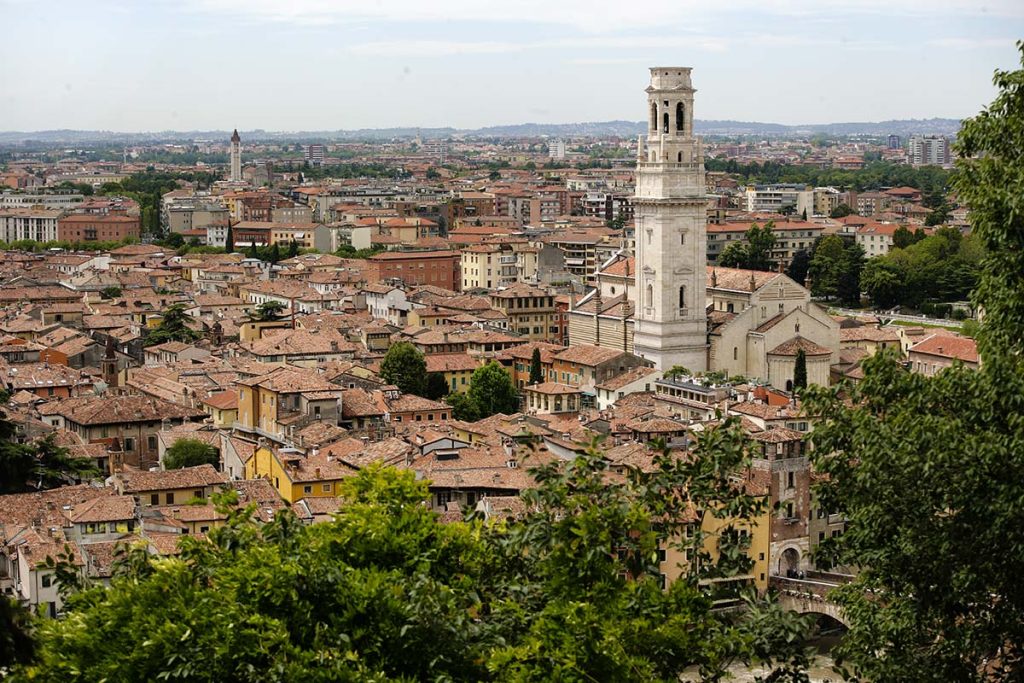
Crossing Ponte Pietra is best just before sunset, the glorious golden light plays across all the historical buildings on one side and the rolling hills on the other. Actually, this bridge, well parts of it, were built around 100BC, and it’s the oldest bridge in Verona. On the other side you can take the funicular up to Castle San Pietro and at the top, the city opens up below you. There’s a terrace and restaurant, Re Teodoro, which is perfect for an aperitivo. You simply find a space and stay for a while. If you’re planning to sit down for dinner, it’s worth reserving ahead, especially around sunset.
Further west, and a bit far from where you are right now, is Ponte di Castelvecchio. This bridge was built in 1356 and it’s a postcard symbol of Verona.The arches are uneven, and it was originally designed as an escape route from the city. It s the kind of structure that feels both functional and deliberate, even now.


If you skip dinner at Re Teodoro, I recommend looking for some of the local cuisine… donkey and horse meat. Now before you turn squeamish – it makes sense in terms of the history and geography of Verona. Nowadays, the donkey meat is often slow-cooked into a rich ragu and served over pasta, or as a pizza topping. As for the horse meat, it’s often shredded, kind of like pulled pork, but this is more for tourists. So, instead, head to places that offer the horse steak fillet-style, it’s a lot better.
I found myself thinking about it again after the trip when I came across dehydrated horse meat in a supermarket where I live now in Italy. It felt like something worth trying, if only out of curiosity. I rehydrated it in broth, added a few spices, and ended up using it in a way similar to carnitas. Admittedly, It wouldn’t be the first thing I would naturally reach for, but it tasted better than expected. I prepared it to my wife and her family without much explanation, and the reaction was surprisingly positive.
By the time you leave Verona, its not really one thing you remember. It’s the moments in between that keep coming back. Beyond the amphitheater, Juliet’s balcony, or the view from the top of the hill, it’s something less defined. It almost feels like Verona is breathing through its streets. The way they narrow, then open again, and how the crowds gather and disperse.
Verona doesn’t present itself as one fixed version of a city. It’s layered, uneven in places, constantly being worked on, and still very much in use. It’s that cycle that makes me want to return, to see what has shifted over time. It feels less like something preserved, and more like something still in the process of becoming.