
Travel Stories from the Road
Milan in Layers: Finding Beauty Beneath the Surface
Apr
I walked into Milan without a plan, no shot list, no checklist, nothing. I just knew I wanted to spend time in the city and photograph whatever pulled me in.
That felt right for Milan, honestly, because this is not a place that gives itself away immediately.
For a lot of Italians, it is easy to understand the visual appeal of somewhere like Florence. The beauty is obvious. Renaissance facades, warm tones, balance, symmetry – it is all right there in front of you in an open air museum.
Milan works differently. It makes you look longer. It asks you to notice what is happening between one era and the next, between one block and another, between old stone and newer glass. It is a city of layers, and a lot of its beauty only starts to show itself once you stop expecting it to behave like the rest of Italy.
That is exactly why I like photographing it.
A lot of that visual interest comes from contrast. Milan has this way of placing history and modern life right beside each other without making either one feel out of place. You see a contemporary tower rising in the distance beyond older streets and facades. You see modern art sitting confidently outside traditional buildings. You get these little collisions between elegance, business, age, movement, and design, and somehow it all still feels coherent. For a photographer, that gives you a lot to work with.
For this trip, I brought my Canon R5 Mark II with a new 35mm lens I was excited to use, plus a PolarPro ShortStache filter because I wanted to play a bit with atmosphere and tone. I also had my 70-200 mounted to my even more trusted 5D Mark IV. It ended up being a good combination for Milan – one setup that kept me close to the street and one that let me compress layers and isolate details when the city started stacking up in front of me.
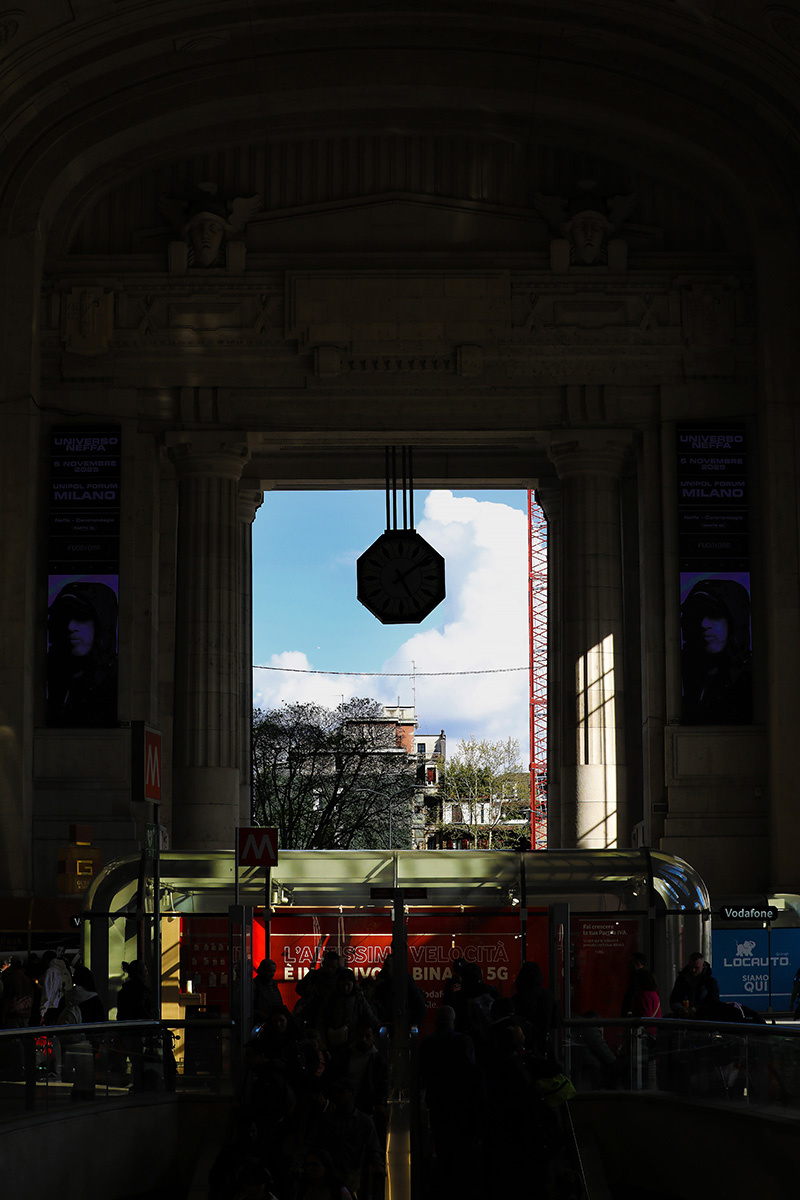
I started at Milano Centrale, and that station alone is ridiculous to photograph. It’s honestly one of the most beautiful train stations in Italy. That almost makes it a problem, because when you’re trying to take on a city like Milan, you want to get moving, but you can barely make it 30 feet without getting photographically distracted.
Once you step outside, the facade is massive, heavy, almost overpowering if you stand in front of it and try to take it in as one complete thing. So instead of trying to capture all of it, I tilted my lens upward and focused on pieces. That felt much more interesting to me. The station already has enough presence on its own. It does not need help. You just have to decide which part of that scale you want to bring into the frame.
I had barely even left the station and I was already having a great time, which made me laugh a little because people still love to describe Milan as dull. I think a lot of them come here for business, fashion, or events, and never really give themselves time to wander. They move through the city with a purpose, which means they miss so much of what makes it visually interesting.


That walk from Centrale toward the center is part of the point. Before you even get to the Galleria or the Duomo, Milan starts giving you material. Different buildings start pulling at your attention for different reasons. One block feels formal and ordered, another opens up into broader, tree-lined stretches that change the rhythm completely. Then, in the distance, you start catching glimpses of skyscrapers that remind you this city never sits still for very long. That contrast kept happening as I walked – older facades, cleaner boulevards, distant modernity, then smaller details pulling your attention right back down to street level.


That is one of the things I like most about photographing Milan. It does not hand you one obvious scene and call it a day. It keeps feeding you different ideas as you move. You can be looking at something elegant and historical, then a few minutes later find yourself drawn toward a totally different frame because of the way the skyline suddenly appears beyond the trees, or the way a boulevard opens up and changes the light.
If you stay open to that rhythm, the city starts guiding you.


That is also how you end up in Piazza della Scala, which is the kind of place that could be easy to pass through if you are too focused on reaching the next landmark. It is worth slowing down. The statue of Leonardo da Vinci has a quiet presence to it.
It is not exactly hidden, but it does feel like one of those details you notice more fully when you are not rushing. For a city people often reduce to fashion, finance, and speed, that square struck me as a reminder that Milan’s identity runs much deeper than the stereotype.

From there, the Galleria felt like a natural continuation rather than some isolated monument. I saw Milan’s first, many, many years before I eventually saw the one in Naples, and only later did I fully appreciate how much the two spaces speak to each other. You can feel that in the confidence of the place, in the scale of it, in the iron and glass overhead, and in the way the whole space seems designed to make you slow down and look up, all around, and just be present in the beautiful environment that you’ve wandered into. It’s the world’s oldest still functioning shopping arcade, and it has aged well.
It is one of those places where photography can become deceptively easy, but also quite difficult if you are not careful. The symmetry is already there, certainly, but there are so many lines, and often a constant flow of people. Which angles will you choose, which lines will you follow? You never run out of interesting photographs here. And that is part of what makes this part of Milan so rewarding.
But, the visual experience does not stop inside the Galleria, it pulls you outward, into the piazza and inevitably toward the Duomo itself.


I remember in 2019 deciding to climb to the top of the Duomo, and it opened up a whole new perspective. It was a gray day, so honestly I wasn’t expecting to capture much.
And then, when I crossed that threshold of the last step I remember looking up and just thinking that it looked gothic. Like, right up the top there you can shoot these statues against a grey backdrop and really zone in on the textures, the play of shadows and the illusions they seem to create.
Some people talk about gray weather like it ruins a city, but for photography it can be a gift. Bright sun in Italian cities often means you are constantly fighting extremes – blown skies above and dark, underexposed streets below. Gray skies soften that whole equation. They give stone texture and make it easier to keep shooting without everything falling apart in the highlights and shadows.

But, on this particular trip I was much more lucky with the weather. So, I met up with my wife’s cousin (What up Anto!) and we headed to Tutti Fritti for a couple beers. And then made our way to dinner at Ristorante Indiano Shiva, which was excellent. After dinner, we had a night cap at Tipota Pub with a couple of Antonio’s friends and we headed in for the evening. I knew the next day was going to be long, and I needed to get up at sunrise to capture what I wanted to, but I will never turn down a great night out.


The next morning I was up at 6:45, and I was out the door by 7:00. The plan was simple: Hoof it like I was on a mission, a quest of utmost importance. A foot-bound voyage into the unknown, capturing treasures and inspiration, anything and everything that Milan had to offer in one fluid motion for the next 10 hours. But seriously, first I needed at least a couple long coffees, a spremuta, and a solid pastry.
Once I was feeling reunited with the realm of the living, I started my day by first heading to the Navigli, which up until this point had been one of my favorite areas in Milan to visit later in the day. In the morning, though, it feels completely different.

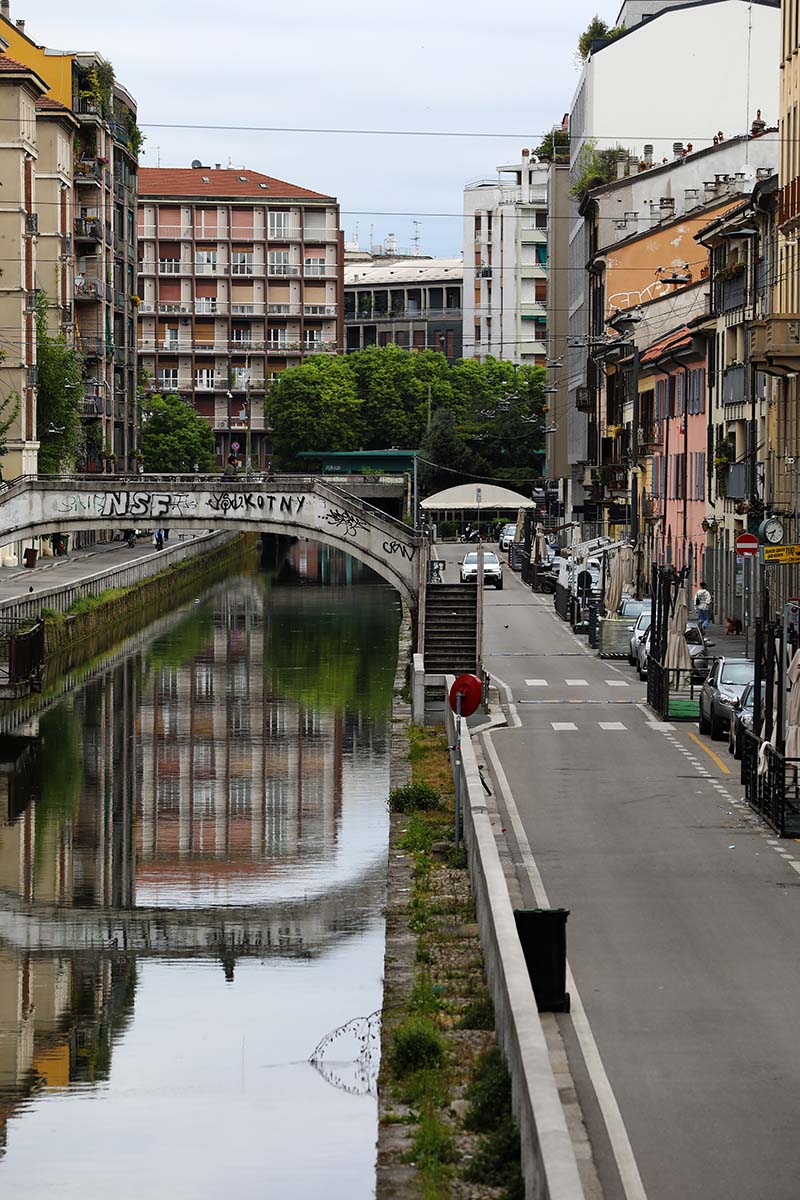
I usually like having people in my photos because they add rhythm, scale, and a sense of life. They can turn something from simply beautiful into something felt.
At the same time, empty streets have their own kind of power. They let the structure of a place speak more clearly. Navigli gave me both.
As the city started waking up, I found myself doing what street and travel photography so often becomes… waiting. Waiting for someone to enter the frame. Waiting for a bike. Waiting for a tram. Waiting for some small unknown thing to happen that would shift an image from clean to complete.
That part matters more than people think.
A strong building is not always enough on its own. Sometimes architecture gives you the frame, but life is what gives it tension. A passerby, a cyclist, a tram cutting through at exactly the right second – those details bring scale, movement, and a pulse to the image. They make it feel lived in.
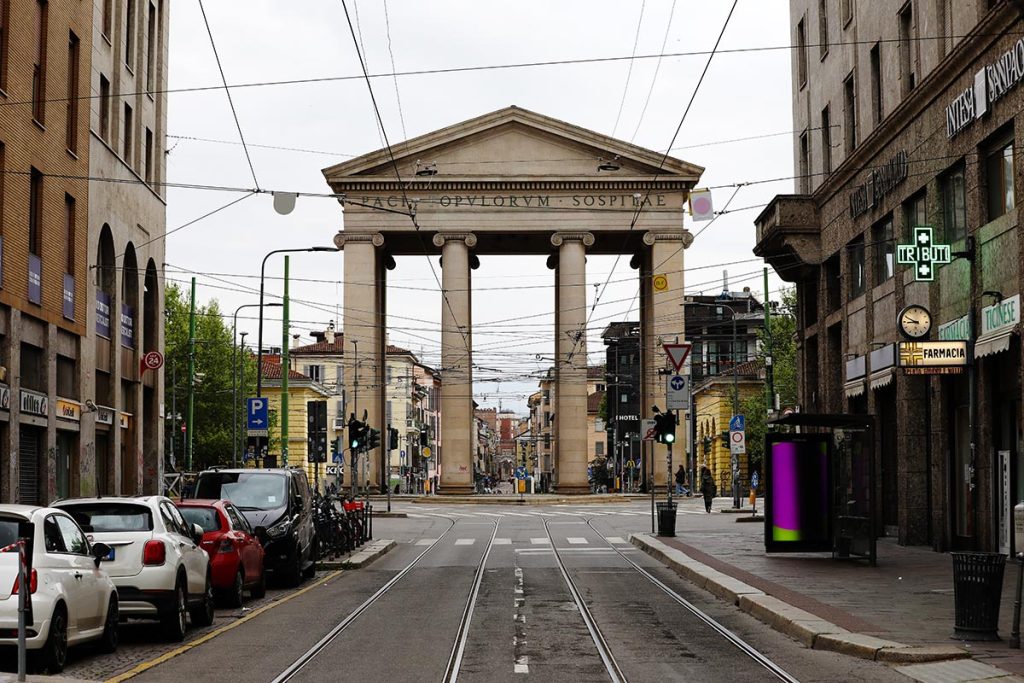
One of my favorite examples from the trip came when I found this beautiful archway and just stood there with my camera ready. The composition was already there. All it needed was the right interruption. For a while, nothing happened. Then suddenly a tram cut right through the center of the frame.
That was the shot.
You can feel it when it happens. That little shift from ‘almost got it…’ to “YES!”.


When I’m visiting, I like to let my feet guide me. That is often where the photographs begin anyway, not at the famous places but in the movement between them. A doorway catching side light. Repeating windows on an aging facade. The rhythm of arcades. Reflections in tram glass. Small studies in texture and geometry that accumulate as you walk.
Some of my favorite frames in Milan came from those in-between moments, when I wasn’t looking for a subject so much as noticing how the city kept arranging itself.
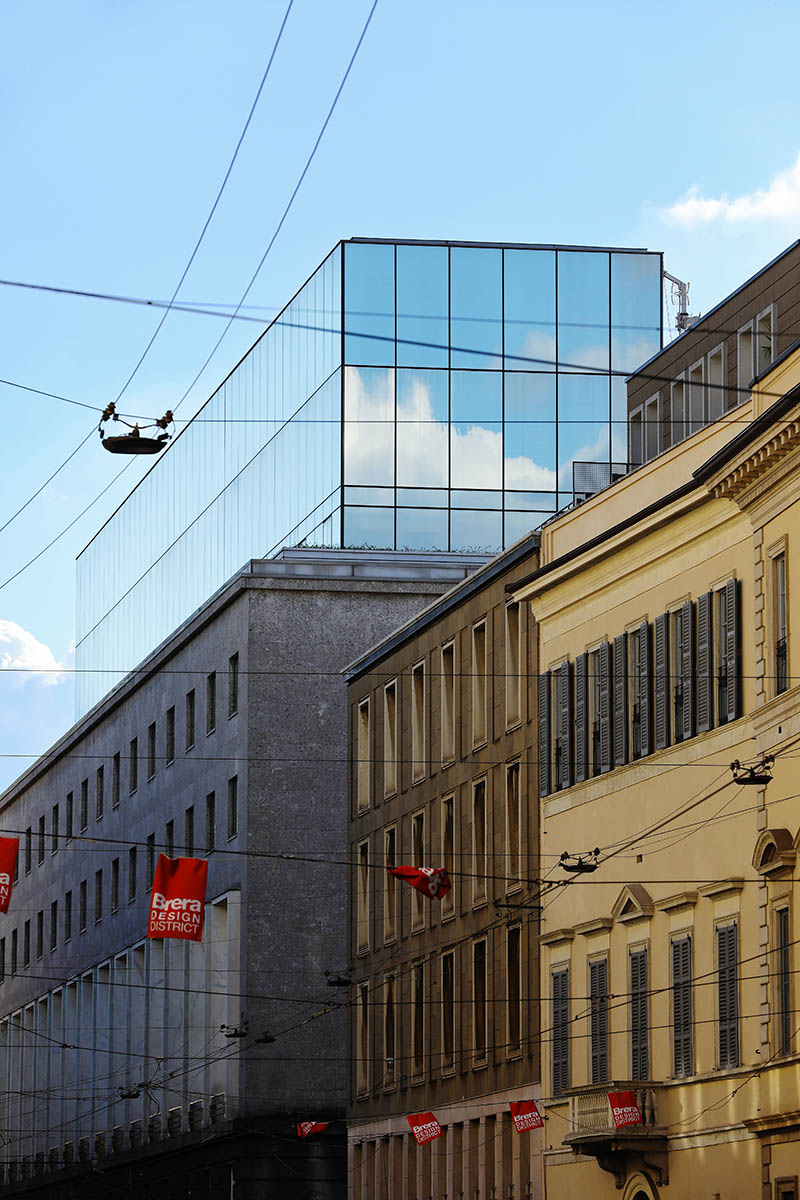
What stayed with me was how often Milan offered layers inside a single frame. Historical ornament beside modern lines. Weathered surfaces interrupted by graphic forms. Even ordinary street views carried this quiet dialogue between permanence and reinvention.
Walking became less about moving between landmarks and more about reading those overlaps.

Near Stazione Milano Cadorna, I came across the Needle, Thread and Knot, and it stuck with me because it felt so Milan. Bold, graphic, modern, symbolic, and completely at ease in a city with this much history behind it.
You can’t see it from here, but the really cool thing about this statue, Needle, Thread and Knot that I think most people might miss is that the statue is actually two pieces. You can find the other piece across the street, so the whole artistic installation is actually a thread and needle appearing to be sewing the city back together, which is honestly such an awesome concept. Props to the artists Claes Oldenburg and Coosje van Bruggen for this amazing idea.

After scoping out the statue, I started exploring the Cadorna station a bit, as it has some very interesting angles and subject material that you can find around. In particular near and under the covered walkway in front of the station which was pretty interesting, as was simply people watching and not being in any particular hurry to go anywhere in particular.


One of the newer additions to my personal list of Milan photography spots was a ground-level fountain I stumbled onto near Stazione Cadorna, close to the castle. It was one of those accidental finds, the kind that holds you there much longer than expected.
I started playing with shutter speed, trying different ways of rendering the movement of water, and what began as a brief pause turned into an extended study. And that’s the thing about Milan. Some of the best images aren’t planned. They’re found by staying curious just a little longer.

From there it was time to head to Castello Sforzesco. I almost always recommend the castle area, and not just because it is an important landmark. For photographers, it is one of those places where small shifts make a big difference. The textures in the stone are great, the geometry is strong, and the surrounding space gives you room to experiment in this concept of overlapping.
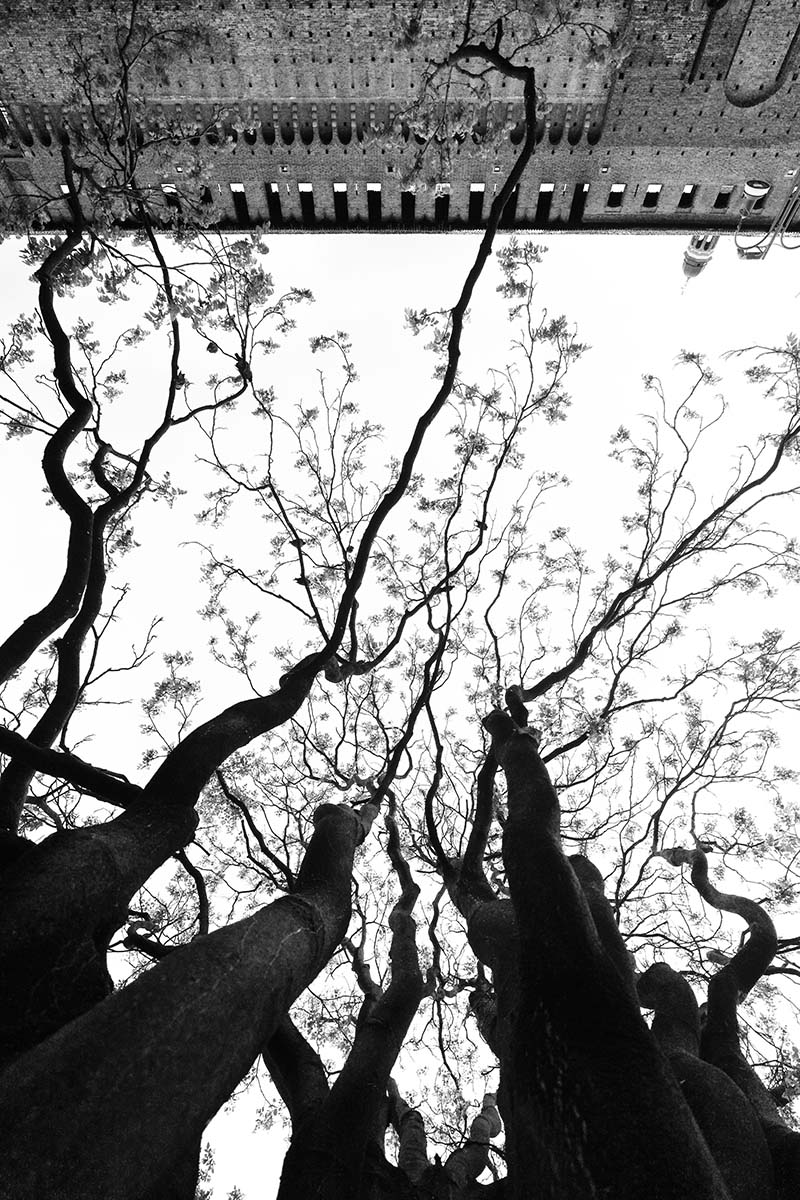
At first I was exploring isolations and symmetry with the tower, just letting the brickwork and negative space do the work of quiet attention. Then, circling the castle grounds, I found points of compression, where rough stone in the foreground pushed against the fortress beyond. What interested me across these frames was how material and perspective could carry mood, how repetition, weight, and partial views could make history feel tactile.


One of the best ways to shoot the historical and contemporary mix is to walk from Castello Sforzesco toward the Brera district and back toward the Duomo.Walking through that neighborhood alone gives you such a dynamic range of subject material to choose from, as it gives you some of the clearest examples of Milan’s layered identity. Stone, glass, ornament, minimalism, age, commerce, design – it all starts overlapping. For photographers, that overlap equates to limitless inspiration and shooting material.


Shooting in Milan constantly reminds me that composition is rarely about finding one spectacular, static subject. When nothing immediately stands out, the work shifts. It becomes about noticing what changes when you move, and how the scene reorganizes itself around you. A step to the left, a pause, a slight shift in timing – suddenly the image exists.
Milan is not a city where you run out of things to photograph. It is a city where a single visual idea can hold your attention for half an hour, if you let it.


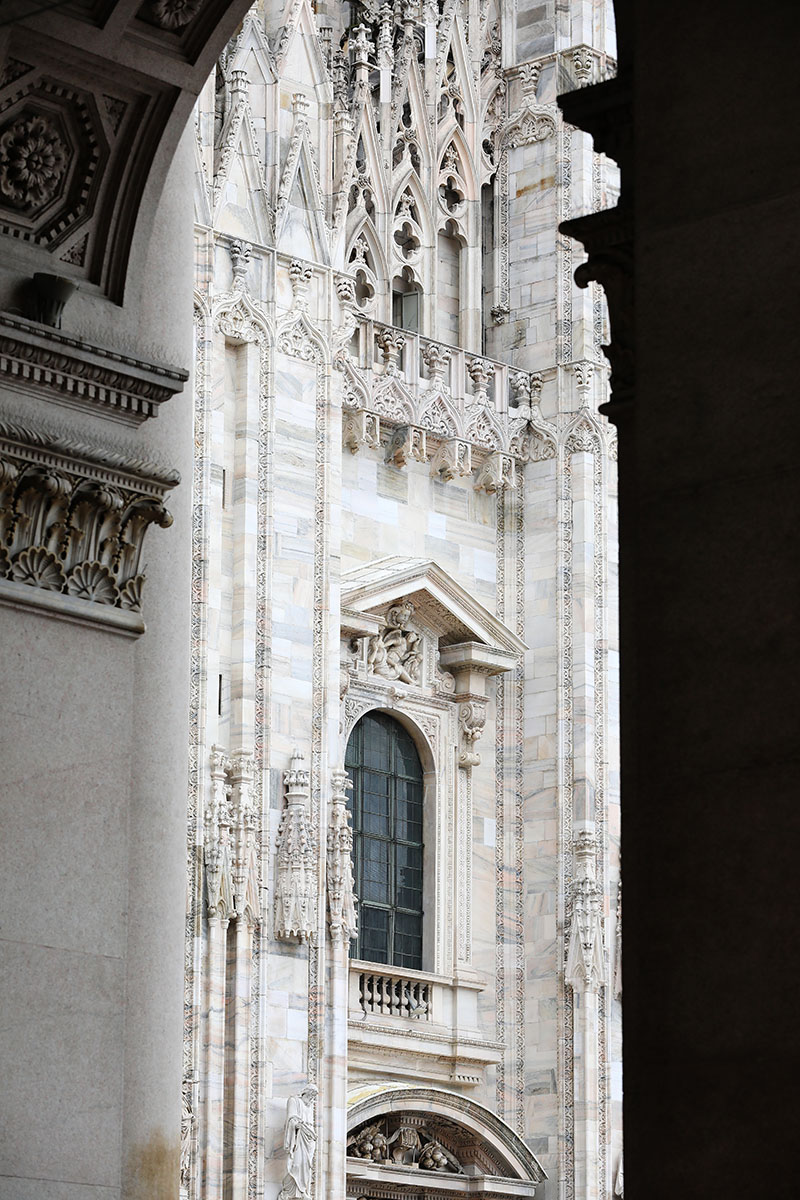
That is the part I think people miss. Milan is often framed as the ‘New York’ of Italy – business, fashion, design, people moving with purpose. It is not usually described as beautiful in the same immediate way as other Italian cities, though that is not entirely fair either. The Duomo is about as direct as beauty gets. Its facade, spires, marble, and scale are impossible to ignore.
The quieter beauty of Milan shows up differently. It lives in the layers, in alignments, in reflections, in the way old facades and modern surfaces can sit in the same frame without canceling each other out.Looking through these images – the stillness of Navigli in the early morning, a tram crossing at exactly the right second, the Duomo facade filling the frame – Milan does not feel like a gray city. It feels like depth. A place that rewards patience, curiosity, and attention, while still giving you moments that stop you immediately.
That is when Milan starts to make sense.
That is when it becomes beautiful.

Photography Landmarks (all walkable cluster in the center)
- Piazza della Scala
- Galleria Vittorio Emanuele II (the “Galleria”)
- Duomo di Milano
- Castello Sforzesco
Food & drinks
Area
Stations
For more places and in-depth resources about things I recommend here, check out my Milan Pocket Guide.